Let the Gravy Find Its Own Way: Why a Cooked Plate Beats a Styled One
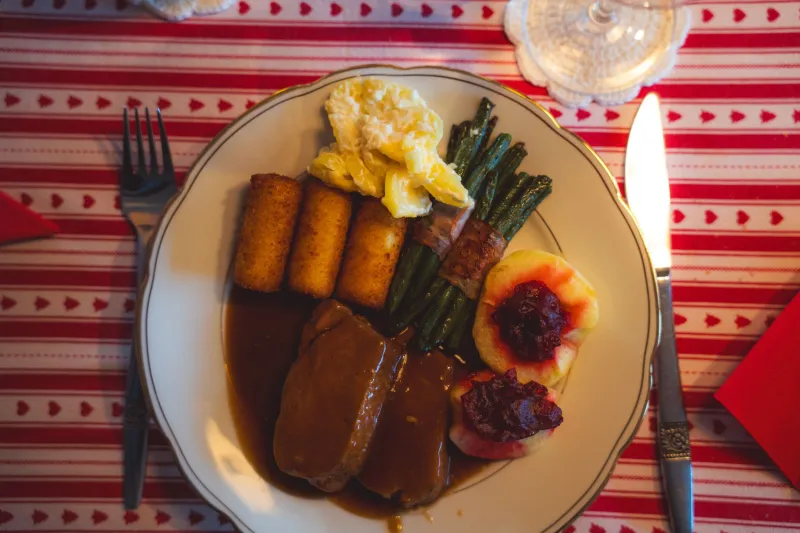
At Hima Mmas, we have a running joke about the perfect plate. It shows up in glossy photos: three identical slices, a neat swoosh of gravy, a sprinkle of herbs placed like confetti. It is beautiful. It is also not dinner. Dinner is what happens when someone is hungry, the kitchen is warm, and the food has to get to the table before the mashed potatoes go cold.
That is why we keep coming back to the slightly imperfect plate. The one with the roast carved a little thicker on one end. The one where the gravy has found its own path across the potatoes. The one with a cornbread square that crumbled at the corner because it was cut while it was still warm. None of that is a flaw in our book. It is proof that a person cooked for people, not for a camera.
The first plate never matches the picture
There is a moment in every home kitchen when the food is ready and the cook has to decide: fix it or feed it? Maybe the green bean casserole has a crumb trail down the side of the dish. Maybe the sliced tomatoes are not all the same thickness. Maybe the pot pie filling bubbled over and left a little browned edge on the crust. You can chase the picture, or you can put on a mitt and carry the dish to the table.
We usually choose the table.
That does not mean we do not care how food looks. We care plenty. A good plate should look like it belongs to the meal. It should look generous, warm, and easy to eat. But there is a difference between food that looks inviting and food that looks engineered. One says sit down. The other says stand back and admire my work. Only one of those is hospitality.
What a lopsided plate is telling you
An uneven slice of meatloaf tells you somebody carved it by hand. A pool of gravy that settles on one side of the plate tells you it was poured from a pitcher, not piped from a bag. A family-style platter with a serving spoon still in it tells you the table is meant to be passed, not photographed from above.
At Hima Mmas, we like food that carries the marks of its making. The cast-iron skillet with a little shine left from the last batch of cornbread. The sheet pan with one corner more browned because that is where the oven runs hot. The bowl of mashed potatoes with a few small lumps because they were mashed by a person who was also watching the gravy and answering a question about whether there was more bread.
Those are not mistakes. They are signatures. They tell you the food came from a real kitchen with real hands and a real clock ticking.
The camera can eat first somewhere else
We are not anti-beautiful. We are pro-fed. But we do think the pressure to make every dinner look like a photo shoot has gotten a little out of hand. Somewhere along the way, a lot of home cooks started apologizing for food that tastes good because it does not look like it was styled by a professional. They see a smooth, symmetric plate online and feel like their own table is falling short.
It is not.
Your Sunday supper is not supposed to look like a restaurant tasting menu. It is supposed to look like your Sunday supper. That means the good china might be mixed with the everyday plates. The napkins might be paper. The gravy might be in a mug because the gravy boat is still in the back of the cabinet. The food is still good. The people at the table are still lucky.
Small habits that protect the cooked look
If you want your food to look a little more cared for without turning dinner into a styling session, start with warmth. Warm plates, warm platters, warm serving bowls. Food looks better when it is not fighting a cold piece of ceramic. Next, serve family style more often. Put the dish in the middle and let people take what they want. A platter with a spoon in it is more welcoming than a plate that has already been arranged into a perfect little landscape.
Then give yourself permission to stop wiping every rim. A clean rim is nice. A slightly messy rim is not a crisis. The same goes for the serving dish. If the casserole has a little browned edge and a few crumbs on the side, that is not a sign of failure. That is a sign that someone made a casserole.
And when you carve, do not worry about making every slice the same. Cut against the grain, keep the slices a little thicker than you think, and let the pieces be what they are. The person at the end of the table is not going to measure your roast. They are going to be glad it is on their plate.
When to fuss, and when to pass the spoon
There are times to fuss. If the food is undercooked, fix it. If the dish is too hot to carry, protect your hands. If someone at the table has an allergy, take that seriously. Those are the things that matter. Those are the things worth being precise about.
The shape of the potatoes is not one of them. Neither is the exact angle of the green beans. Neither is whether the gravy has a perfect circle in the middle of the plate. Gravy is not a design element. It is gravy. It is there to make the meat taste better and the bread worth reaching for.
We have found that the less we fuss over the look of a plate, the more the table relaxes. People serve themselves. They pass the bread. They ask for a little more gravy. They stop worrying about whether the meal is impressive and start enjoying the fact that it is dinner.
The table is the real filter
A photo can make a plate look perfect for a second. A table can make a meal feel right for an hour. That is the trade we will take every time. The slightly imperfect plate is not a compromise. It is a choice to put people before pictures. It is a choice to believe that food is not a performance. It is a handshake, a welcome, a way of saying there is enough and you should have some.
So if your cornbread is a little uneven, if your casserole has a crumb or two on the edge, if your gravy has decided to go left instead of center, let it. Put the dish on the table. Pull out the chairs. Pass the spoon. The plate does not have to look like a photo shoot. It just has to look like dinner, and dinner is already enough.